10 Best Golf Putting Drills (Stop 3-Putting)
Disclaimer: This post may contain affiliate links. As an Amazon Associate, I earn from qualifying purchases—at no extra cost to you.
If you're serious about lowering your scores, there's no faster way than becoming a better putter. After all, roughly 30-40% of your shots happen on the greens, yet most golfers spend far more time working on technique with a mid-iron than practicing the club they use the most.
The problem isn't that golfers don't practice putting—it's how they practice. Rolling a few balls toward a hole without a purpose might feel productive, but it rarely translates to better performance on the course.
Instead, every practice session should have a goal. Some drills should improve your mechanics, others should sharpen your speed control, and the best ones add pressure so you can build confidence when it matters most.
10 Best Golf Putting Drills
Below are my favorite putting drills that I've used over the years to become a plus-handicap golfer. These drills combine everything you need to become a complete putter: better mechanics, improved distance control, more confidence on short putts, and the ability to perform under pressure.
Some are perfect for the practice green, while others can be done at home with an indoor putting mat like PrimePutt or PuttOut. No matter your skill level, these drills will help you eliminate three-putts and start making more birdies.
1. The Tiger “Two Tee” Gate Drill
One of the best putting drills ever created is the Two-Tee Gate Drill, made famous by Tiger Woods. As he said in an interview, " I do it incessantly before every round. I do it at home, I do it everywhere. I did this for hours as a kid. How it gets there it doesn't matter.
I can take it inside, I can take it way outside and loop it back. But with the tees there. I have to hit the ball flush, and present a square face at impact."
The goal is simple: roll the ball cleanly through two tees placed just slightly wider than your golf ball.
This drill instantly exposes poor face control. If you clip either tee, you'll know your putter face wasn't square at impact. Over time, you'll develop a much more consistent start line, which is one of the biggest keys to making more putts.
Want to make it harder? Try hitting putts with only your trail hand (or lead hand). One-handed practice improves face awareness, helps eliminate excess hand action, and builds a smoother stroke.
You can also use the WhyGolf Putting Thing (one of my favorite putting training aids) instead of tees to create different difficulty levels. Pair it with an indoor putting mat, and you can get in five to ten minutes of quality practice almost every day.
2. Learn to Lag Putt
If you struggle with three-putts, your issue is usually speed control, not green reading.
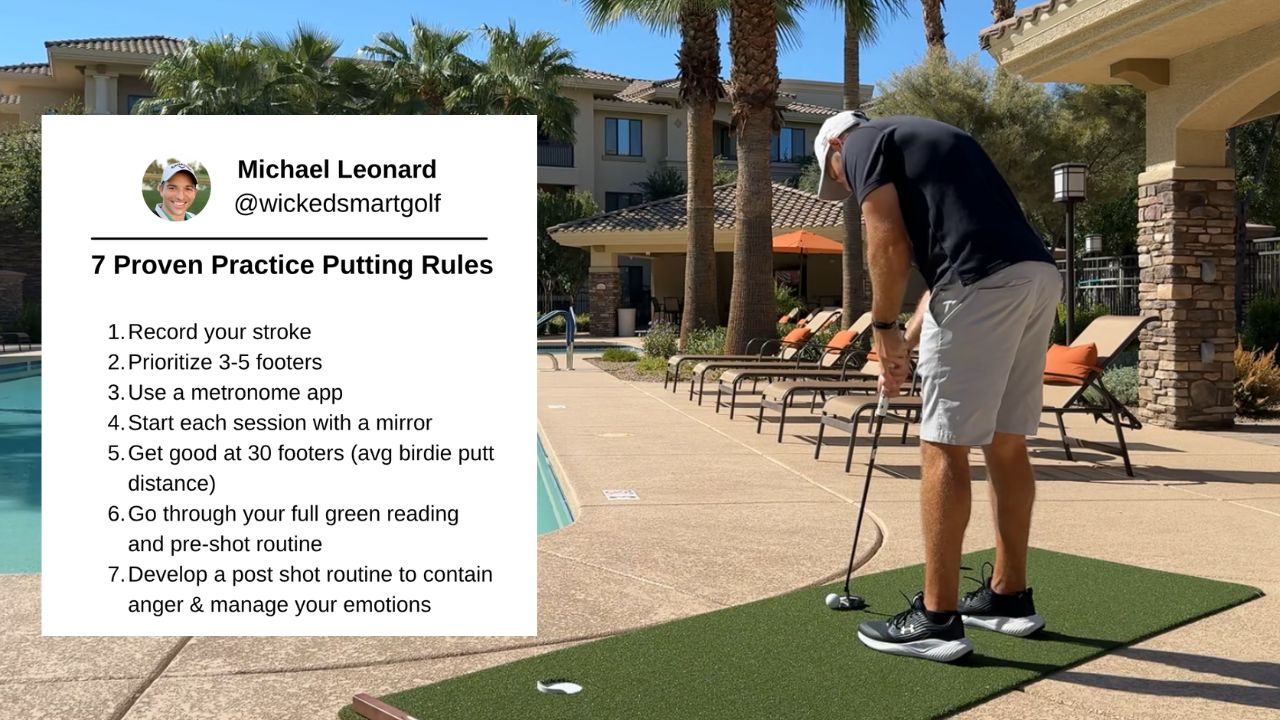
One of the easiest ways to improve your distance control is by practicing with a metronome. Great putters keep a consistent tempo regardless of whether they're hitting a 5-footer or a 50-footer—the only thing that changes is the length of the stroke.
Download a free metronome app and experiment with a tempo between 67 and 76 BPM. Use the first beep to start your backswing and the second beep for impact.
Then spend 10-15 minutes hitting putts from 20 to 50 feet, matching your stroke to the rhythm. You'll quickly develop better touch, improve your lag putting, and leave yourself far more tap-ins instead of stressful four- or five-foot comeback putts.
3. Alignment Stick Speed Drill
This is one of my favorite drills for improving lag putting and speed control.
Find two holes roughly 30 feet apart and place an alignment stick about 18-24 inches past each hole. Position the stick on the high side of the cup so you naturally learn to play enough break and miss on the high side.
Now putt back and forth between the holes. Your goal is to finish every putt past the hole, but short of the alignment stick.
To make it competitive, use this scoring system:
- 3 points: Holed putt
- 2 points: Past the hole but short of the alignment stick
- 1 point: Stops within one foot short
- 0 points: Stops within two feet short
- -1 point: More than two feet short or rolls past the alignment stick
This drill teaches perfect pace while reinforcing one of the best habits in putting—letting the ball finish just beyond the hole instead of dying short.
4. Phil Mickelson’s Long Putting Drill
If you want to eliminate three-putts, steal one of Phil Mickelson's favorite practice games.
Set up stations at 40, 50, and 60 feet from the hole. If your practice green is smaller, use 30, 40, and 50 feet instead. Then create a 3-foot scoring zone around the cup using tees.
Starting at the shortest station, go through your full pre-shot routine and get two balls inside the circle before moving back. Once you've completed all three distances, return to the middle station for one final putt to simulate a pressure situation.
Your goal is to finish all seven putts inside three feet. If you're a mid-to-high handicap golfer, inside four feet is still an excellent result.
If you complete the challenge, don't make it easier—find a longer putt or one with more slope and start again. The more variety you add, the better your speed control will become on the course.
5. The Ladder Drill
The Ladder Drill is one of the best ways to develop elite speed control on the greens. Since every putt is a different distance, learning to adjust your stroke length while maintaining the same tempo is a crucial skill.
Place tees at 10, 20, 30, and 40 feet. Hit one ball to each tee, trying to stop it within a putter length. Then "climb back down the ladder" by putting to 30, 20, and 10 feet without resetting.
Complete the drill in both directions before changing locations on the practice green. As your touch improves, tighten your target zone to make the challenge even harder.
6. The Up and Back Challenge
This is one of my favorite drills for learning how to adapt to different distances and green speeds.
Set up three targets at 20, 30, and 40 feet. Hit one ball to each target in order, trying to finish every putt inside a 3-foot circle. Then reverse directions and repeat the drill from 40 back to 20 feet.
The goal is to get all six putts inside the scoring zone. If you complete the challenge, find a putt with more slope, more break, or faster greens and do it again. This is an easy way to add variety and make every practice session more realistic.
7. The Tornado Putting Drill
If you want to become a clutch putter, the Tornado Drill is one of the best pressure games you can play.
Place three tees in four directions in a semi-circle around the hole, starting at 4 feet and moving back one foot at a time until 7 feet. Go through your full pre-shot routine and make each putt in order.
Here's the catch: if you miss more than two putts, you start over from the beginning. That consequence creates real pressure and teaches you to trust your routine instead of worrying about the outcome.
One mistake I see golfers make is refusing to leave the green until they miss. That's not realistic. Remember, PGA Tour players only make about 80% of putts from five feet, so expecting perfection is setting yourself up for frustration.
Instead, use the Tornado Drill to challenge yourself—not punish yourself. Stay committed to your process, embrace the pressure, and celebrate small improvements over time.
8. The 5-8-10 Pressure Putting Drill
This is one of the best drills for building confidence from the distances that matter most.
Place three tees (or coins) at 3, 5, and 8 feet from the hole in a straight line. Start at 5 feet and don't move back until you've completed the challenge at each station.
Your goals are:
- 5 feet: Make 8 out of 10 (PGA Tour make rate: ~82%)
- 8 feet: Make 5 out of 10 (PGA Tour make rate: ~53%)
- 8 feet: Make 4 out of 10 (PGA Tour make rate: ~53%)
This drill matches realistic Tour expectations while adding just enough pressure to make every putt count. If you complete it, find a putt with more slope or break and start over.
9. Play Nine Holes on the Practice Green
One of the biggest mistakes golfers make is practicing without ever using their full routine.
Instead, treat the practice green like you're playing a real round. Grab one ball and a ball marker, remove your headphones, and play nine different putts from a variety of distances and breaks.
Before every putt, go through your complete green-reading and pre-shot routine just like you would during a tournament or weekend round. This bridges the gap between practice and performance, helping your routine become automatic when you're on the course.
Remember, you're not just practicing your stroke—you're practicing how you play golf.
10. Clock Drill
Place four balls around the hole at 3 feet each so you hit different breaking putts. Make them all by going through your full routine
Repeat this with four footers, then five footers. If you miss, start over!
Bonus: Create Your Putting Routine
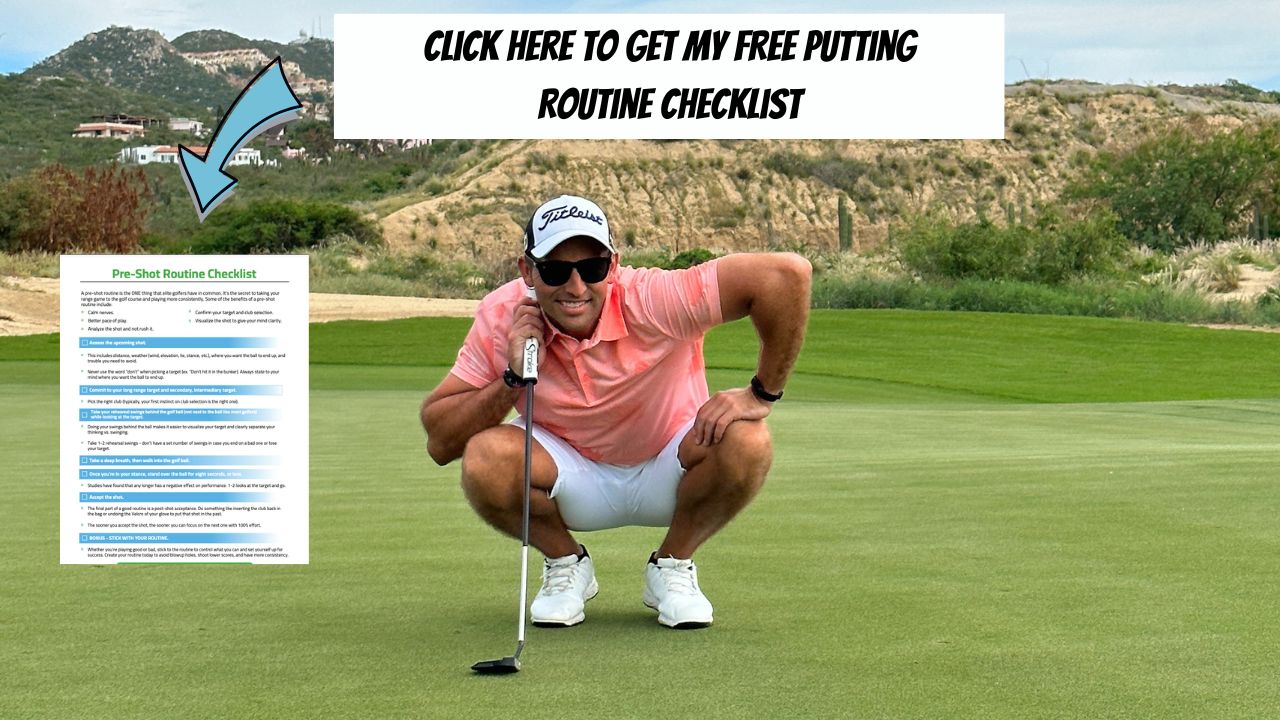
The best "putting drill" isn't really a drill at all—it's developing a consistent routine you can trust under pressure.
Experiment with three different styles: rehearsal strokes next to the ball (Tiger Woods), behind the ball (Scottie Scheffler), or no rehearsal strokes (Cam Smith). Test each one on short, medium, and long putts to see which gives you the most confidence.
Once you find your routine, stick with it. A repeatable process builds confidence, improves consistency, and makes it much easier to perform when the pressure is on.
Remember, try to keep your total time over the ball to eight seconds or less. The easiest way to work on your routine? Using an at home putting mat like PrimePutt.
My Experience
After 10+ years of tournament golf, I've learned that the best putting drills are the ones you actually do consistently.
That's why I always start my practice sessions on the putting green. If I tell myself I'll practice putting after hitting balls, it usually gets skipped. By putting first, I know I'm improving the part of the game that has the biggest impact on scoring.
I also recommend gamifying your practice as much as possible. Keep score, create consequences, beat your previous best, or compete against a friend. Pressure games like the 3-5-8 Drill and the Tornado Drill have helped me become much more comfortable over those must-make putts.
More than anything, use your full putting routine more frequently. After playing 450+ tournament days since 2016, I can confidently say routines are one of the biggest separators between golfers who putt well in practice and golfers who putt well when it matters.
Closing Thoughts
The best putting drills don't just improve your stroke—they improve your confidence, speed control, and ability to perform under pressure. Combine a few of these drills into every practice session, and you'll quickly eliminate three-putts while making more of the putts that matter.
If you want a complete step-by-step system to become a better putter, check out the Wicked Smart Golf 21-Day Putting Challenge. Inside, you'll get 3+ hours of bite-sized training where I'll teach you my simple 7-Step Confident Putting Framework to improve your green reading, speed control, routine, and confidence on the greens.
In just 21 days, you'll have a proven practice plan to stop three-putting, make more short putts, and finally trust your putting when the pressure is on.