Golf Nerves: How to Cure Jitters & Anxiety Fast
Disclaimer: This post may contain affiliate links. As an Amazon Associate, I earn from qualifying purchases—at no extra cost to you.
Golf nerves are part of the game—don’t let anyone tell you otherwise.
I’ve interviewed PGA Tour players, elite coaches, and some of the best sports psychologists in golf, and one thing is clear: great players still get nervous. Even Tiger Woods has talked about feeling nerves in competition.
The goal isn’t to somehow eliminate them forever; it’s learning how to perform when they show up.
Whether it’s the first tee of a tournament, a must-make putt, playing with better golfers, or simply trying to finally break 80, pressure means you care. In this guide, I’ll share practical strategies to help you manage golf nerves, calm anxiety, beat first tee jitters, and play with more confidence when it matters most.
Golf Nerves: How to Cure Jitters & Anxiety Fast
One of the worst pieces of mental golf advice is, “Just don’t care so much.”
That makes no sense. You practice, spend money on lessons and equipment, dedicate hours to improving, and probably think about golf way too much. Of course you care, and there’s nothing wrong with that. Caring is part of what makes golf rewarding.
Instead of trying to become emotionally detached, you need tactical ways to handle nerves when they appear. The best players aren't fearless; they have routines, breathing strategies, mental cues, and other tools that allow them to keep executing despite the pressure.
That’s what the tips below will help you develop: not a way to magically stop caring, but a repeatable process for staying composed, committed, and focused when the butterflies inevitably show up.
1. Reframe as Excitement, Not Nerves
First-tee jitters are real. Whether you’re a 20-handicap playing with strangers or a PGA Tour player competing for millions, nerves are part of golf.
I’ve experienced plenty myself. One of my worst first tee shots ever came during a college tryout when I dead-topped a driver into a creek—with the coach and entire team watching. Somehow, I recovered and eventually earned a spot on that same college team.
The lesson I learned much later is that you don't need to eliminate nerves—you need to reframe them.
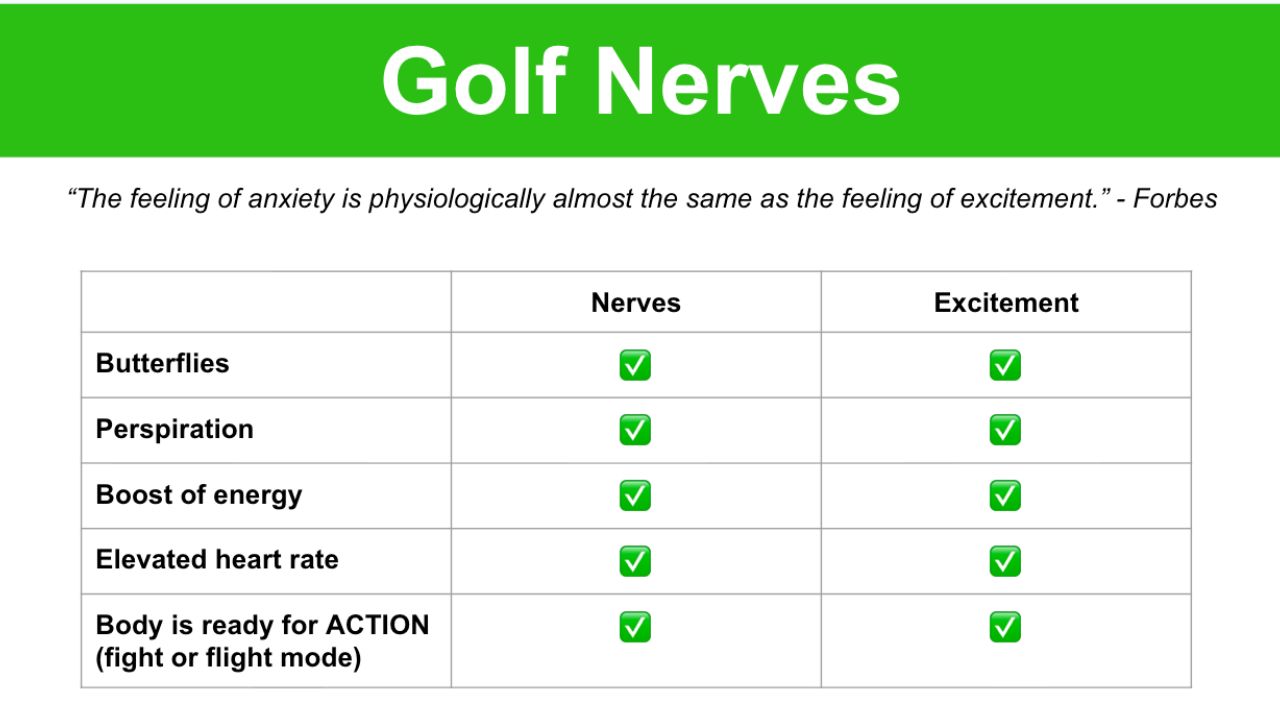
Even Tiger Woods has talked about getting butterflies before competition. Those feelings are there because you care. Instead of telling yourself, “I'm so nervous,” change your internal dialogue to: “I'm excited.”
Nervousness and excitement create many of the same physical sensations: increased heart rate, alertness, and energy. Your interpretation of those sensations can change how you respond to them.
So when the butterflies arrive, don't fight them. Get them flying in formation.
Take a few deep breaths, commit to your target, trust your pre-shot routine, and swing confidently. Nerves aren't necessarily a warning that something bad is coming—they can be a sign you're ready to compete.
2. Keep Your Expectations in Check
A lot of golf anxiety comes from expecting yourself to play better than your ability—or expecting perfection because the round suddenly feels important.
You might think, I practiced all week, so I should hit every green. Or, this is a tournament, so I can't make a double bogey.
Those expectations create unnecessary pressure.
Even the best golfers in the world miss fairways, miss greens, hit terrible shots, and three-putt. Yet amateur golfers often walk onto the course expecting themselves to suddenly become ball-striking machines because they're playing an important round.
Instead, give yourself permission to play imperfect golf.
You're going to hit bad shots. You're going to get bad breaks. You might make a three-putt or dump one into a bunker. None of those moments mean the round is over.
Lowering expectations doesn't mean lowering your standards or not caring. It means understanding the reality of golf so every mistake doesn't feel like an emergency.
Play with whatever game you brought that day. Stay patient, choose smart targets, and stop comparing every shot to your best golf.
You don't need 18 perfect holes to shoot a great score. You need to manage your misses, stay mentally engaged, and keep moving forward.
3. Warm Up Strategically
Your warm-up can either build confidence or create anxiety before you ever reach the first tee.
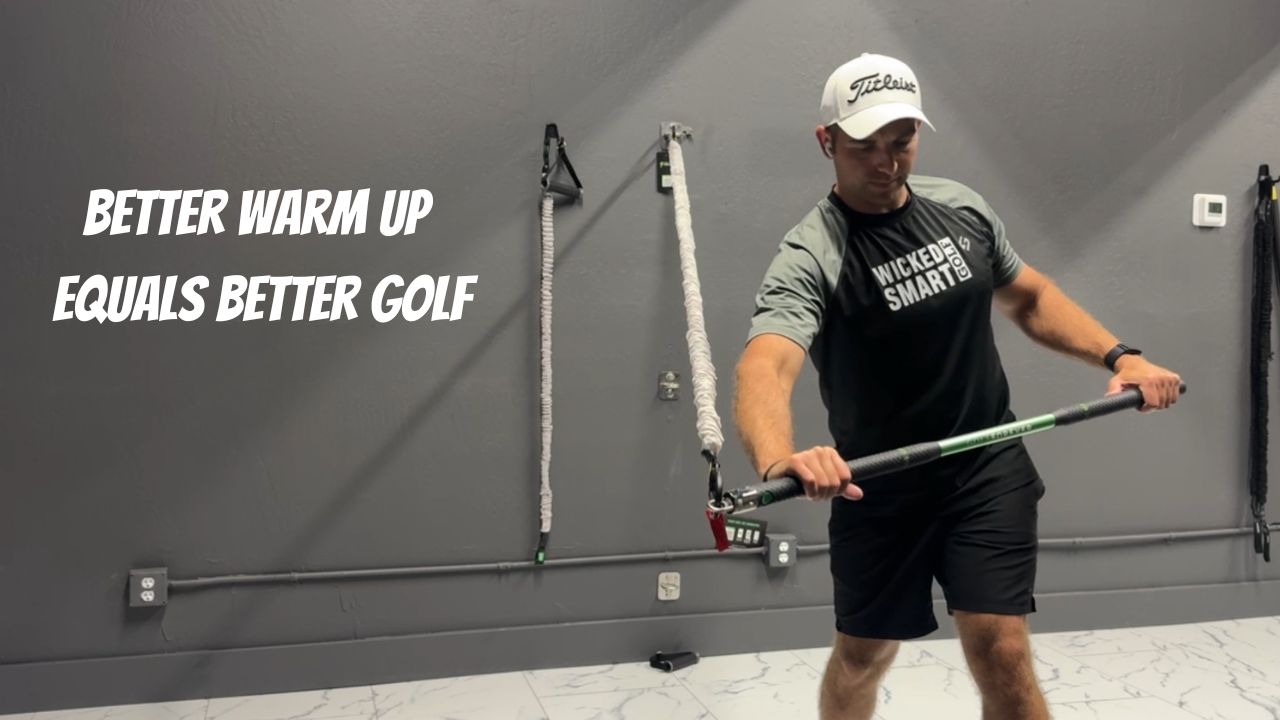
In an ideal world, start at home with a short dynamic warm-up to loosen your hips, shoulders, and back. Tools like GolfForever or Dynamic Golfers are great ways to get your body moving before you hit a golf ball.
More importantly, give yourself enough time at the course. Arriving late, rushing through check-in, and sprinting to the range is an easy way to start the round stressed and flustered.
Once you're there, use your warm-up to create confidence—not evaluate your golf swing.
I like starting on the putting green by making plenty of short putts. Seeing the ball go in immediately creates positive momentum. Then work through your normal short game and range routine without trying to fix your swing based on a handful of shots.
Before leaving the range, hit the exact shot you plan to hit on the first tee. Pick a target, use the correct club, and go through your complete pre-shot routine.
Finally, have clarity on your strategy for the opening few holes by using an app like Shot Pattern (the best golf GPS). By the time you reach the first tee, the goal is to feel like the round has already started—your body is ready, your mind is calm, and you know exactly what you're trying to do.
4. Have a Pre-Shot Routine
If nerves tend to take over during important rounds, your pre-shot routine is one of your best defenses. I can’t tell you how many times I’ve been super nervous (like Q-school) and leaned on my routine to focus and direct my energy in the right direction.
When pressure increases, it's easy to start thinking about everything except the shot in front of you: your score, swing mechanics, hazards, what other people are thinking, or what happens if you hit a bad shot.
A routine gives your mind somewhere productive to go.
Before every shot, make a clear decision, commit to a specific target, visualize the shot, take your rehearsal swing, breathe, and then step in and trust it. The exact routine can vary from golfer to golfer, but it needs to be repeatable.
Also, please don't abandon it when you're nervous, that's when you need it most.
I've played hundreds of tournament rounds and worked with golfers on the mental side of the game, and the pre-shot routine is one of the first things I focus on. It creates familiarity when everything around you feels uncomfortable.
You can't control whether you feel nervous. You can't control where every shot finishes.
But you can control your preparation before every swing. That's why I believe a great pre-shot routine is one of the closest things golf has to a mental-game cheat code.
Learn more about Pre-Shot Like a Pro Masterclass to create effective routines.
5. Breathe for Better Golf
One of the fastest ways to calm golf nerves is something you already do thousands of times per day: breathe.
Your breathing patterns send signals to your brain. Deep, controlled breaths signal that things are okay, while short, shallow breathing can increase tension and reinforce the fight-or-flight response.
Unfortunately, pressure makes it easy to forget this. Your heart starts racing, your breathing gets shallow, your grip tightens, and suddenly your normal golf swing feels completely different.
That's why I intentionally use breathing throughout a round.
Before the first tee, you should take several slow breaths through your nose. Use another deep breath before stepping into your shot as part of your routine. After a bad shot or frustrating hole, breathe again to help reset before moving forward.
As Byron Nelson said, “One way to break up any kind of tension is good deep breathing.”
Don't wait until you're overwhelmed, either. Pay attention to your breathing while walking between shots, waiting on the tee, and approaching important putts.
Better breathing helps reduce tension, slow everything down, and remind your brain that hitting a golf ball isn't a life-or-death situation. My favorite breathing app is Neuropeak Pro if you need some assistance.
6. Try the 10-2 Tension Trick
Nerves don't only affect your thoughts—they show up physically.
Your grip gets tighter. Your shoulders tense up. Your arms stop moving freely. Suddenly, the motor pattern you've practiced thousands of times becomes much harder to execute naturally.
That's why I love a simple exercise I learned from Dr. Izzy Justice: the 10–2 tension trick.
Hold your club and squeeze it at a 10 out of 10—as tightly as possible. Then release almost all that pressure until you're holding it at roughly a 2 out of 10.
Go back to 10. Then back to 2.
Repeat this several times and notice the difference between excessive tension and a relaxed grip. The contrast helps you become much more aware of how unnecessarily tight you might be holding the club when you're nervous.
Golf requires speed, rhythm, touch, and coordination. Excess tension interferes with all of them.
You don't need to somehow think yourself into being less nervous. Sometimes the fastest solution is physical: release the tension, soften your grip, breathe, and let your trained motion happen.
7. Play More Golf
Sometimes golf nerves aren't really a mental-game problem; they're a frequency problem.
Think about a comedian preparing to film a Netflix special. They don't write an hour of material and show up to the taping hoping it works. They perform dozens of smaller shows, test jokes, get uncomfortable, make adjustments, and build confidence through repetition.
Golf works the same way.
If you only play one tournament per year, it's unrealistic to expect yourself to suddenly feel comfortable under tournament pressure. The environment feels different because you don't experience it often enough.
Play more competitive golf.
Enter club events, money games, qualifiers, local tournaments, or anything else that makes you care about the result. The more frequently you put yourself in uncomfortable situations, the more normal they start to feel.
And when you play casual rounds, play by the Rules of Golf whenever possible. Hole everything out. Don't take mulligans, play bad lies and keep a real score.
Give yourself opportunities to experience pressure instead of avoiding it. Confidence isn't built by waiting until you feel ready.
It's built through evidence and repetition. Put yourself in pressure situations more often, and eventually they won't feel nearly as intimidating.
My Experience
After hundreds of tournament rounds, I can tell you one thing with certainty: nerves are part of golf.
I still get nervous as a +2 handicap, and I don't expect that to ever completely disappear. Instead, I've learned to rely on the strategies above—reframing nerves as excitement, controlling my breathing, sticking to my routines, managing tension, and putting myself in pressure situations more often.
These are also the same strategies I teach my mental golf coaching students. The goal isn't to become a robot who never feels anything. It's to develop tools you can trust when your heart rate increases and the round means more than usual.
Most importantly, stop treating nerves like they're evidence that you're not ready. They're normal and show that you care.
Accept them, use your tools, and keep playing.
Closing Thoughts
Never forget: you can hit incredible golf shots while you're nervous.
I remember standing on the 36th hole of a tournament knowing I had the lead. Of course I was nervous—the tournament mattered to me. But I didn't need the nerves to disappear before I could perform.
I breathed, committed to my target, visualized a clutch shot, trusted my pre-shot routine, and hit a huge drive when I needed it most. Then I went on to win.
That's the goal of mental golf training. Not eliminating pressure, but learning how to execute despite it.
The next time you're nervous, don't panic because your hands are shaking or your heart is racing. Reframe it as excitement, breathe, soften your grip, and focus on the process you've practiced.
If you want to build a stronger mental game and learn the complete system I use to play competitive golf, join the Wicked Smart Golf Academy. You'll learn how to develop better routines, manage your emotions, practice with purpose, make smarter decisions, and play better golf—without constantly changing your swing.