Golf Swing Thoughts: Stop Overthinking, Start Playing
Disclaimer: This post may contain affiliate links. As an Amazon Associate, I earn from qualifying purchases—at no extra cost to you.
What are the best golf swing thoughts to have during a round?
As a competitive golfer and mental golf coach, my answer might surprise you: as few as possible.
The better you get at golf, the more you tend to understand your swing. That can be helpful during practice, but it can also become a curse on the course.
Suddenly, one bad drive has you thinking about your takeaway. A missed iron has you questioning your transition. Before long, you’re trying to fix your golf swing instead of actually playing golf.
I’ve made this mistake countless times myself.
After playing hundreds of tournament rounds, getting to a +2 handicap, and coaching golfers on the mental game, I’ve learned that my best golf almost never happens when I’m consumed with mechanics.
It happens when I trust my preparation, commit to targets, stick to my routine, and react to the game in front of me. That doesn’t mean you can never have a swing thought.
But there’s a massive difference between one simple cue that helps you swing freely and trying to manufacture your golf swing consciously. In this guide, I’ll explain how to use golf swing thoughts correctly, why swing feels are often better than technical thoughts, and how to stop becoming your own swing coach in the middle of a round.
Golf Swing Thoughts: Think Less, Play Better
One of the biggest mistakes I see golfers make is taking their practice mindset onto the golf course.
The driving range is where you work on your golf swing. You can use video, training aids, drills, launch monitor data, and technical thoughts to improve a movement. That's practice.
Playing a round of golf requires a different mindset.
The Problem With Swing Thoughts
Once the round begins, your job is to take the swing you have that day and figure out how to score with it. You're choosing targets, reading lies, managing misses, controlling emotions, and committing to one shot at a time.
Unfortunately, golfers love trying to fix things mid-round and have you thinking:
- Hit a block? I need to release the club.
- Pull the next one? Now I'm coming over the top.
- Hit one fat? I need to shift my weight better.
Within three holes, you've accumulated five different swing thoughts and completely lost trust in your natural motion. I've interviewed PGA Tour players and coaches about this exact subject, and the message is remarkably consistent: when golfers perform their best, they're generally not consciously thinking about complicated mechanics.
That's the approach I want you to take from this article.
I'll teach you how to stop analyzing your swing mid-round, the difference between swing thoughts and swing feels, and why setup cues are often more effective than mechanical ones. Plus, how to find one simple anchor you can trust when your swing doesn't feel perfect.
Because ultimately, your goal isn't to create a technically perfect golf swing while you're playing. It's to get the ball in the hole in the fewest number of shots possible.
The 3 Best Types of Golf Swing Thoughts
Telling yourself to “think about nothing” on the golf course isn't very realistic. Your mind is going to focus on something, especially when you're struggling or the pressure increases.
The goal is to give it something productive to focus on.
Mechanical swing thoughts don't belong on the golf course. As Dr. Bob Rotella said, “A golfer must train his swing on the practice tee, then trust it on the course."
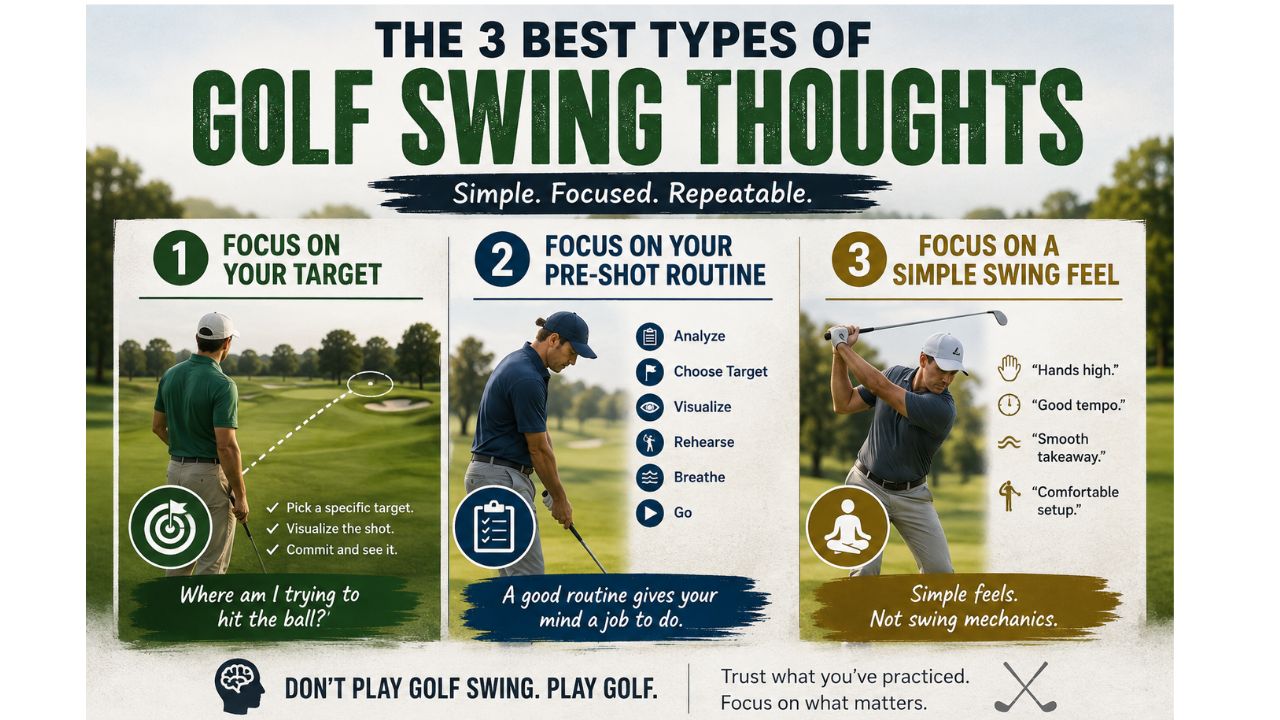
Instead of thinking about your takeaway, wrist angles, transition, or a dozen other positions, shift your attention toward one of these three areas: your target, your routine, or a simple swing feel.
1. Focus on Your Target
Golf is a target sport, yet it's amazing how quickly we forget about the target when things aren't going well.
Hit one bad drive, and suddenly you're thinking about your backswing. Miss an approach shot and you're analyzing your transition. But none of those thoughts answer the most important question before every golf shot:
Where am I trying to hit the ball?
Target selection should happen early in your pre-shot routine. Pick a specific target—not simply “the fairway” or “the green.” Find a tree, bunker edge, discoloration on the green, or another precise reference point that gives your brain clarity.
Then visualize or verbalize the target before stepping into the shot.
Dr. Izzy Justice, a neuroscientist I've interviewed extensively, has helped me understand the importance of repeatedly feeding the brain the picture you want. He says it's similar to think about it like painting a wall. One coat of paint might work, but four coats make the color much stronger.
Your target works similarly.
The earlier you choose it and the more attention you give it, the clearer the picture becomes. Look at it during your rehearsal swings. Visualize the ball traveling toward it. Then make your target one of your final looks before starting the swing.
This is also why constantly changing targets during your routine is such a problem. Every time you second-guess your decision, you're essentially repainting the picture.
Pick the target. Commit to it. See it. Trust it.
When your mind wants to obsess over mechanics, keep bringing it back to the reason you're swinging in the first place: send the golf ball toward your target.
2. Pre-Shot Routine
If you're someone who tends to have five swing thoughts bouncing around your head, focus on your pre-shot routine instead. A good routine gives your conscious mind a job to do before your subconscious takes over and swings the club.
Rather than standing behind the ball thinking, Don't come over the top... keep my head down... don't get quick... make sure I turn, your attention shifts toward a repeatable process.
Analyze the lie. Get your yardage. Choose the right club. Pick your target. Visualize the shot. Take your rehearsal swing. Breathe. Walk in. Aim. Look at the target. Go.
I've played hundreds of tournament rounds, and this is one of the biggest mental-game lessons I've learned: the more pressure I feel, the more important my routine becomes.
Your routine creates familiarity when the situation doesn't feel familiar.
It also keeps you focused on things you can control. You can't guarantee where the golf ball will finish, but you can control whether you make a clear decision, commit to your target, and prepare for every shot the same way.
This is something I emphasize constantly with my mental golf coaching students because routines need to be trained, not simply understood.
It's also why I created my Pre-Shot Like a Pro Masterclass. I wanted golfers to have an actual system for building and practicing a routine instead of relying on generic advice like “just focus” or “don't think about your swing.”
When your mind starts getting mechanical, don't try to shut it off. Give it a process to follow.
3. Simple Swing Feel
Sometimes you need something related to your swing during a round (especially if you’re making swing changes), and that's okay. The key is choosing a simple swing feel instead of a complicated mechanical swing thought.
This distinction changed the way I think about my own game when several guests shared this on the Wicked Smart Golf Podcast.
The goal is simple: take your mechanical motions and turn them into simple feels. Things like:
- “Hands high.”
- “Good tempo.”
- “Smooth takeaway.”
These aren't instructions for consciously controlling the golf swing. They're cues that help my body recreate a motion you have already practiced.
I also prefer that you have a setup feel whenever possible. Alignment, posture, ball position, or feeling comfortable over the ball can solve problems without trying to manipulate the club during a swing that lasts roughly one second.
I recommend having a few reliable feels that you've already tested in practice. You can even write them on a small notecard and keep them in your yardage book.
But don't invent a new one after every bad shot.
Find your feels on the range. Trust them on the course.
And if you catch yourself becoming your own swing coach halfway through the round, return to one of the other two options: your target or your routine. That's how you stop playing golf swing and get back to playing golf.
My Experience
The more elite players, sports psychologists, and coaches I interview, the more obvious this becomes: great golf is not played with a mind full of mechanics.
The best players aren't standing over the ball trying to consciously control five different parts of their swing. They're focused on the bigger things—their target, their routine, and a simple feel when needed.
I've experienced this firsthand in my own tournament golf.
When I shot my lowest tournament round of 65 in 2026, I had zero technical swing thoughts. I wasn't thinking about my takeaway, transition, wrist angles, or anything else mechanical. I had an insane level of focus on my target, committed fully to each decision, controlled my breathing, and trusted my routine.
The same has been true when I've won amateur events and played some of my best golf under pressure. That's not a coincidence.
The technical work was done before the tournament. Once I got on the course, my job changed from training my swing to trusting my swing.
Closing Thoughts
Don't let YouTube University and social media convince you that your golf swing is a never-ending construction project.
There is a time to work on mechanics. If you're making a swing change, train it strategically on the range, use drills, get feedback, and put in enough repetitions to make the movement more automatic.
But eventually, you have to stop training and start trusting.
When you get to the golf course, resist the urge to diagnose every bad shot. Focus on your target. Commit to your routine. Use a simple swing feel if you need one. Then react to the shot and move on.
Play golf—not golf swing.
That's also the philosophy behind the Wicked Smart Golf Academy. Instead of giving you more random swing tips, the Academy helps you improve the parts of golf that actually help you score: the mental game, smarter practice, putting, short game, routines, and course management.
If you're tired of constantly tinkering with your swing and want a proven system to help you play better with the game you already have, join the Wicked Smart Golf Academy and start playing wicked smart.