The B29 Blue Brick Review: Worth The Money?
If you’ve ever fought an over-the-top move, struggled to shallow the club, or can’t seem to compress the ball consistently, you know how frustrating it is. You watch video, you rehearse the move, you “feel” like you’re making changes and then the next swing looks exactly the same.
Sound familiar? If so, that's why tools like Blue Brick Golf exist.
Instead of relying on feel, it gives you a physical reference point that forces better swing mechanics. In this B29 Blue Brick review, I'll share more about my experience with this popular training aid.

The B29 Blue Brick Review
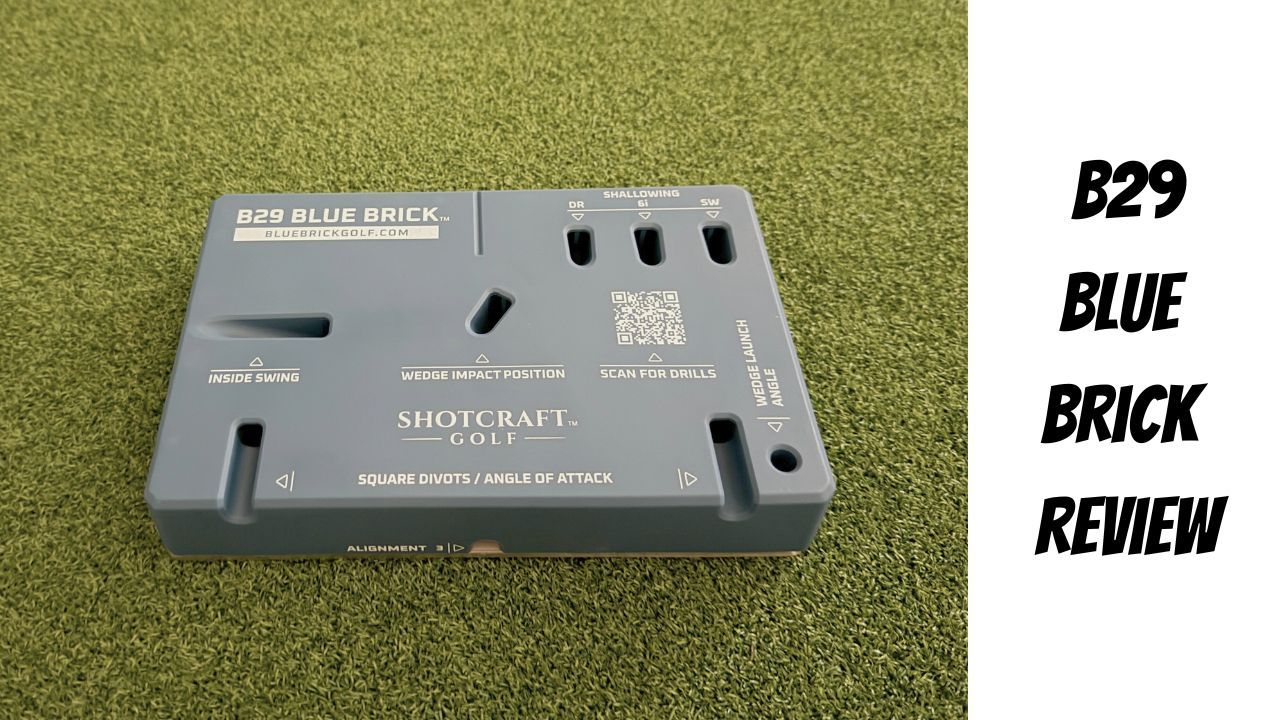
The B29 Blue Brick is a small, swing aid built around one principle: create physical constraints so you can’t make your old swing. It was designed by Clay Ballard, who runs the wildly popular YouTube channel, Top Speed Golf.
That Blue Brick itself is simple; no sensors, no app and no data overload. Just pure, immediate feedback in this 11-in-1 training aid.
You place the Blue Brick on the ground, slide alignment sticks into the angled slots, and suddenly you have a customized swing-path station that shows you exactly where the club should and shouldn’t go.
If you reroute the club too steep in transition? You’ll hit the stick.
If you flip at impact or lose shaft lean? The stick will catch you again.
How Blue Brick Works (and What’s Included)
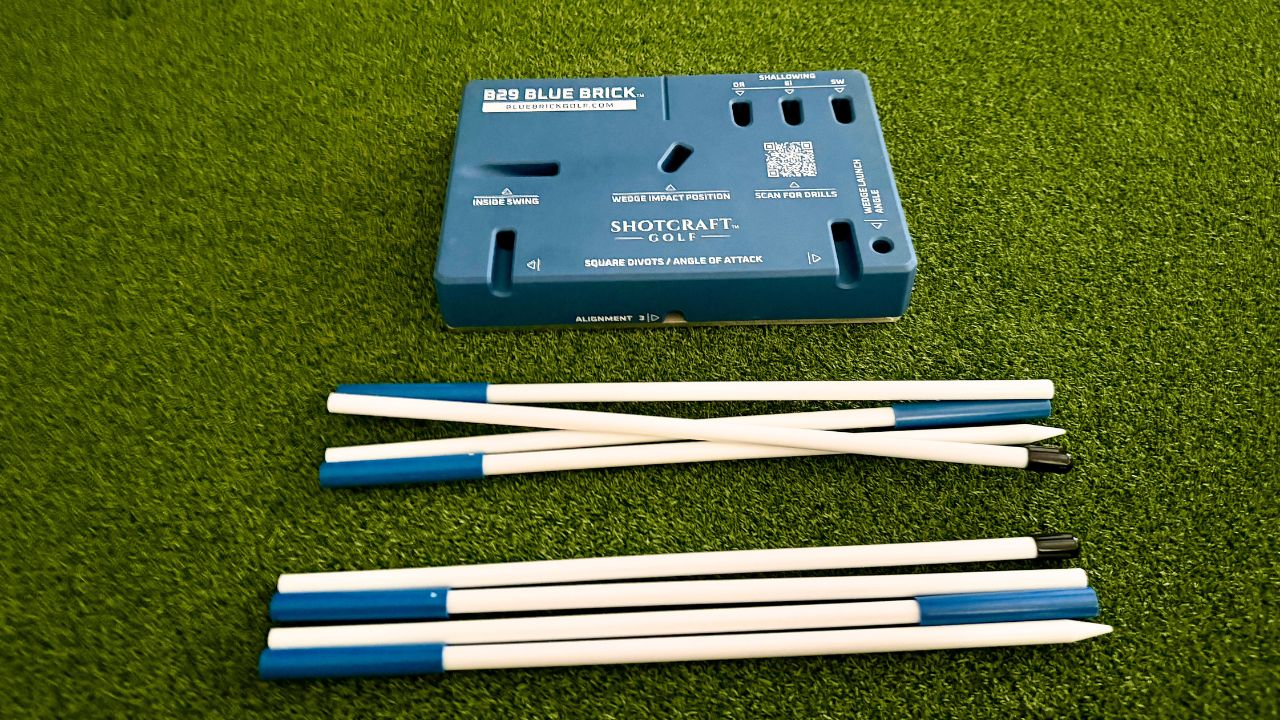
The Blue Brick unit itself is compact and designed to work with any standard alignment sticks. The package from Blue Brick Golf includes two foldable sticks, but you can use any you already own. Although I have to say, I like the foldable option!
The premise is simple: stop swinging so steep (arguably the biggest mistake from amateur golfers). As Clay mentioned on the website, pros swing at or just under 60* plane with a 6-iron (more with a wedge, since it's a shorter club and producing a steeper plane). While pros swing longer shaft clubs like driver at 45*.
This is why there are several positions to insert the alignment sticks, depending on the club you're hitting. His premise is that when you swing under the plane (as he refers to it, "the shallowing line"), you'll hit it longer, straighter, with more contact.
As someone who's had countless lessons on this subject and battled a steep plane, I couldn't agree more.
Getting Started
Setup with the Blue Brick takes less than 30 seconds:
- Place the Blue Brick behind the ball.
- Choose the slot that matches the drill you’re working on (ex. driver, 6-iron, or sand wedge).
- Insert a stick to create your “avoid this” boundary.
- Insert another stick in the bottom part of the device to align with the target.
- Start swinging and don't hit the stick.
The angled slots let you focus on different parts of the swing, including:
- Shallowing the downswing
- Creating an inside-to-out path
- Stopping the over-the-top move
- Improving low-point control
- Building proper shaft lean and compression
- Setting a consistent alignment and ball position reference point
It’s also turf-friendly and mat-friendly, which makes it an easy add-on for home nets and garage practice.
11 in 1 Training Aid
The main goal of the B29 Blue Brick is to help you shallow the club. However, it's also touted as an 11-in-1 training aid because it helps with other golf swing issues, including:
- 2 slots for creating square divots.
- Practicing an inside swing path to hit draws.
- 3 slots to help with alignment and ball position.
- A slot to help you create forward shaft lean (perfect for wedges).
Wedge Practice
Not only does it help shallow the club with all clubs in the bag, it also helps dial in wedges. With the Blue Brick, you can use it to improve wedge launch angle, wedge impact position, and battle an inside swing. It's a little more complex to use for this in my opinion but can help provide feedback.
There is a QR code you can scan to get more information on how to use as well + drills from Clay to build a more consistent golf swing.

Pros of the B29 Blue Brick Training Aid
After testing it for multiple swing paths and impact drills, here are the standout strengths:
1. Forces You Into a Better Downswing
If you tend to get steep, cast the club, or reroute over the plane, Blue Brick gives you instant accountability. You’ll know immediately if your transition is wrong.
It’s one of the fastest ways to learn the feeling of actually shallowing the club.
2. Helps You Compress the Ball More Consistently
A lot of golfers struggle with “slap” contact because they lose shaft lean. With the impact-zone setup, you train a forward-leaning shaft and more forward low point—which leads to that clean, compressed sound we all want.

3. Perfect for Indoor Use
Because it sits low to the ground and doesn’t require perfect turf, it’s ideal for golfers who practice:
- In a garage
- In a spare room
- On a mat
- In a simulator studio
If you’ve ever done winter practice or offseason training, this is exactly the kind of tool that keeps your swing sharp.
4. A Visual + Physical Feedback Combo
Some tools are only visual and some are only feel-based. Blue Brick gives you both.
You see the proper path → then feel the correction the moment you miss it. That type of blended feedback accelerates learning dramatically.
Cons of the B29 Blue Brick Training Aid
Now that you know more about the pros to this training aid, what about the downsides? Here’s what I found:
Very Heavy = Not Portable
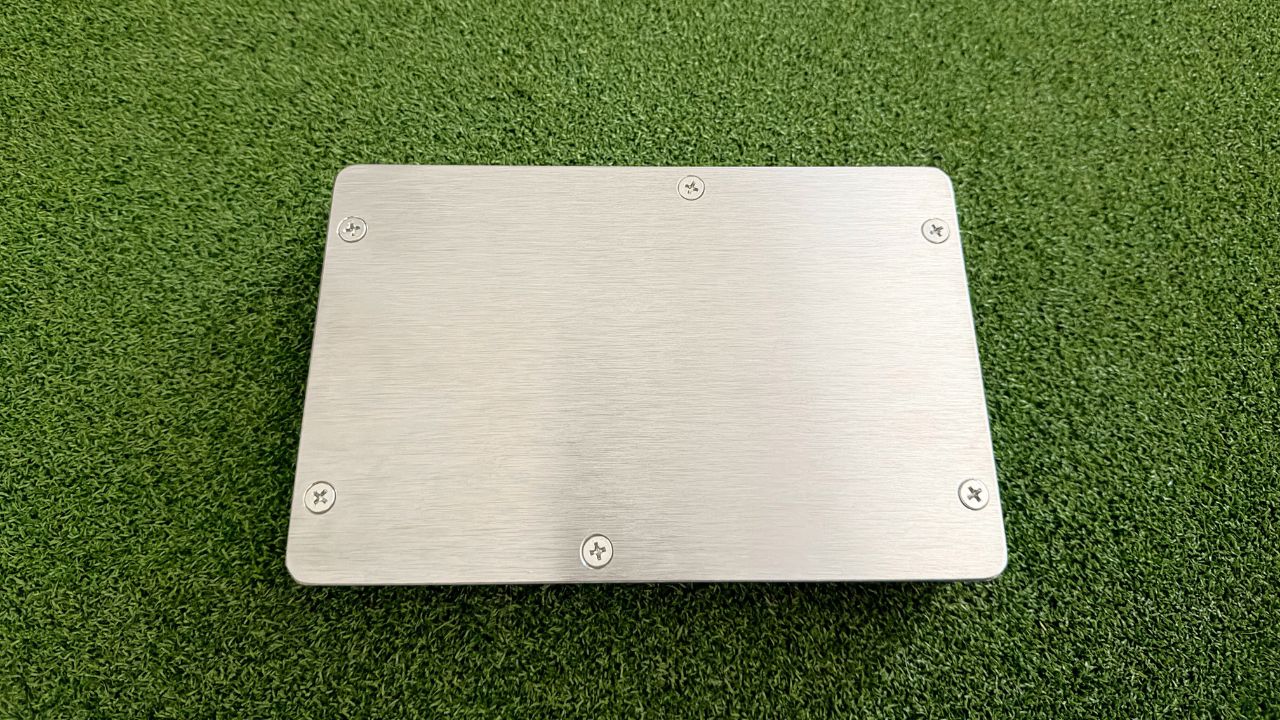
The Blue Brick itself is heavier and chunkier than most training aids. It’s not something you’ll toss in your bag and bring to the range every session. Realistically, this is a “keep it in your trunk or in your garage” tool—not a travel-friendly training aid.
Because of its size and weight, you’re unlikely to bring it to the range as often as other training aids. Forget about flying with it in your golf travel case—it takes up too much space and doesn’t pack flat like alignment sticks or compact tools.
Expensive
Blue Brick is not cheap at $169 - yikes!
That’s more than Rypstick speed trainer (aka the best speed trainer in golf). And unlike multipurpose aids (like Tour Aim), this one focuses almost exclusively on swing path, low point, and compression.
You’re paying a premium for a focused tool—which is fine if path is your biggest issue. But it's pretty steep compared to other training aids I love under $100. Additionally, there are plenty of upsells to his masterclasses and membership site too.
But even the brick alone at $169 is a bit steep for the simplicity.
No Short Game or Putting Application
This isn’t a full-practice solution. You can’t use it for putting start lines, chipping lanes, or bunkers. It’s a swing-path tool, period. If you want something that covers all areas of the game, you’ll need a second training aid alongside it.
Best For:
- Players working on shallowing the club
- Golfers who fight a slice or over-the-top move
- Anyone who wants better contact and more compression
- Feel-based learners who benefit from immediate physical feedback
Not Ideal For:
- Golfers looking for a putting or short-game tool
- Anyone expecting a “swing fix” without doing the reps
- Players who already have a stable path and shallow transition
This is a swing-specific tool. If you want a general practice station (alignment, aim, putting), something like Tour Aim is better. But if path and compression are your weaknesses, Blue Brick is laser-focused on those issues.
Read my Blue Brick vs. Tour Aim comparison post to learn more about the differences between training aids.
FAQs
Do I need the Blue Brick–branded alignment sticks, or can I use my own?
You can use any standard alignment sticks, but it does come with two that fold up. The Blue Brick unit is designed to fit universal stick sizes, so if you already have a pair in your bag, you’re set. Their collapsible sticks are convenient, but not required.
Does Blue Brick actually fix a slice or over-the-top swing?
It won’t magically fix your slice—but it does make it almost impossible to keep making the same steep, out-to-in move. By creating a physical barrier, it forces you into a shallower, more inside path.
Combine it with reps and video feedback, and you’ll see real improvement.
Can I use Blue Brick indoors or only on grass?
It’s great indoors. You can use it on mats, carpet, turf, or any flat surface. That makes it perfect for winter training, home practice, or anyone hitting balls into a net and of course, the driving range.
Is this only for full swings, or can I use it for wedges and short irons too?
You can use it for both. It’s especially helpful with wedges because it teaches better low point control and forward shaft lean—two things that help eliminate heavy and thin contact around the greens.
Is Blue Brick good for beginners, or only better players?
It works for any golfer who wants to learn proper swing path early. Beginners benefit because it gives a clear visual of what a good transition should look like (if you set it up properly).
Better players like it because it helps refine path, face control, and contact. If path is the issue, this tool is for you. Making a solid tool for block practice sessions (how I tend to use it) and/or making changes in the offseason.
Closing Thoughts Is Blue Brick Worth It?
If you’ve ever tried shallowing or fixing path by feel alone, you know how hit-or-miss it can be. Blue Brick removes the guesswork by giving you a clear boundary every single swing.
For golfers who struggle with path, steepness, or consistent contact, Blue Brick is a solid choice. I just wish it was a bit cheaper.
It won’t fix mechanics on its own, but it makes the right motion brutally clear. If you want to build a better transition or finally learn to shallow the club, this tool gets you there faster than trying to “feel” your way through it.
Whether you buy this or another training aid, just remember you don't always need to use them in practice. I allocate 25% or less of all sessions with training aids, this way I "take off the training wheels" and am ready to play golf.